By Matthew S. Williams
Introduction
Following the spread of encampments on college campuses in solidarity with the Palestinian liberation movement in the Spring semester of 2024, many colleges and universities put in place strict restrictions on student activism and protest. This was true of my own school, Loyola University Chicago (LUC), even though no encampments happened there. As with many other schools, LUC’s administration restricted protest to a small space on campus—what those of us in the global justice movement of the early 2000s sarcastically called a “protest pit.” This allowed administrators to claim to honor freedoms of speech and assembly, while ignoring the spirit of them. Something that received less attention but was equally disturbing to me was that organizers of campus protests are not allowed to invite off-campus speakers to participate. But student activist groups are most likely to endure long-term when they have relationships with off-campus groups that can mentor them (Williams 2020).

Source: By عباد ديرانية – Own work, CC0, https://commons.wikimedia.org/w/index.php?curid=147749568.
My own non-tenure track faculty union, Faculty Forward LUC, held a protest during contract negotiations, to which we invited student supporters, and to which the President and Vice-President of our local, SEIU Local 73, were invited to speak. We were forced to move to a sidewalk just off-campus to avoid both the students and the speakers from getting on the wrong side of the campus police. A dean was present to engage in surveillance and—to use the administration’s own Orwellian doublespeak—“advise” students on how to protest “safely.” The only danger being, of course, being the administration themselves.
This trend is especially worrying because of the important role of student activism in fostering progressive social change. And it is not isolated. Both in the US and elsewhere, the long-term trend since 2000 has been for college and university administrators to place more restrictions on student organizing (Kapita, Ríos-Jara, and Bratberg 2026).
Bryant William Sculos and Sean Noah Walsh (2016) argue this is the contemporary manifestation of what Herbert Marcuse, a member of the Frankfurt School of philosophy and social criticism, in his 1965 classic piece of the same name, called “Repressive Tolerance.” Marcuse argues that in societies founded on inequality, “the conditions of tolerance are ‘loaded’: they are determined and defined by the institutionalized inequality (which is certainly compatible with constitutional equality)” (p. 2). Authorities both in the 1960s and today invoke tolerance to silence dissent, accusing dissenters of being the intolerant ones. Marcuse said that the tolerance authorities expect is the passive tolerance of the status quo, despite all the social evils such as warfare, colonialism, racism, and sexism that it promotes. Authorities accuse those who protest against what ought to be intolerable of being unwilling to listen to or allow for opinions other than their own. “Tolerance is turned from an active into a passive state, from practice to non-practice: laissez-faire the constituted authorities. It is the people who tolerate the government, which in turn tolerates opposition within the framework determined by the constituted authorities” (p. 1).

Source: By Isaactrius – Own work, CC BY-SA 4.0, https://commons.wikimedia.org/w/index.php?curid=138495165
Sculos and Walsh (2016) emphasize that neither they nor Marcuse called for censoring their opponents, though Marcuse is commonly misread this way. This would be rank authoritarianism of the kind they oppose. And, as events have shown, authorities are as likely to use such capacity to censor against the left as anyone else. Instead, what they advocate is mobilizing people to challenge those in positions of power who perpetuate systems of domination, whether silencing dissent, promoting neo-colonial wars, or papering over the ongoing realities of racism, sexism, and other forms of discrimination.
Student activists don’t have to simply accept this atmosphere of growing repression though. There are ways to organize and protest against it. Indeed, the freedoms of students that are now under attack are not something that have always been part of college life. Student activists of the New Left in the 1960s worked to transform colleges into more open spaces, creating many of the freedoms students until recently often took for granted.
How Student Activists of the 1960s Democratized Campus Life
To get a better perspective on this history, I spoke with one of my graduate school mentors, Bob Ross, who co-founded Students for a Democratic Society (SDS) in 1962 and went on to have a long academic career as a sociologist. For those unfamiliar with this group that played an important role in the movements of the 1960s, Ross says, “SDS was the leading organization of a somewhat broader phenomenon called the New Left. … In 1962, the American left was small, more or less irrelevant, and bitterly divided. … So one of the new things about the New Left was an attempt to overcome those divisions. Second, that attempt took the form of emphasizing the radical potential in the idea of democracy. To democratize life was to include democratizing the economy. We came up with a phrase that was very resonant at the time, still, in fact, participatory democracy. The idea was that democracy is more than every once in a while pulling a lever in a voting booth.”

Source: C. Clark Kissinger, The Guardian (Fair Use)
SDS emerged among college students who supported the sit-ins being conducted by the student wing of the civil rights movement. They also organized the first large demonstration against the Vietnam War in 1965. On the more philosophical side, SDS’s 1962 founding document, The Port Huron Statement (Students for a Democratic Society 1962), was the first to articulate the concept of participatory democracy. (For a general history of SDS and the New Left, see James Miller’s (1987) Democracy is in the Streets; for one focusing on their efforts to create participatory democracy, see Wini Breines’ (1989) Community and Organization in the New Left.)
One of the formative moments in the student New Left was the Berkeley Free Speech Movement (FSM) of September 1964-January 1965. The administration of the University of California, Berkeley responded to tabling by supporters of the civil rights movement with arrests and a blanket ban on political activity on campus. Between 1,500 and 4,000 students gathered on the steps of Sproul Hall. UC Berkeley’s administration responded by authorizing police to engage in mass arrests, leading to 800 students being detained. Ongoing protests eventually forced UC Berkeley Chancellor Edward Strong to not only back down but resign.
SDS member and sociologist Wini Breines (1989) argues that these protests revolved around issues central to the New Left, of which free speech was a part, but were much bigger. The FSM criticized the bureaucratization of university life, under which the focus was on training students to become cogs in the machine. This was part of a larger critique of the growing bureaucratization of the US under the Cold War liberal-managerial state. As an alternative, FSM, SDS and the New Left more broadly articulated a vision of a participatory, democratic community and a university focused on intellectual life, dialogue, and debate.
This was eloquently captured in the classic cri de coeur of FSM member Mario Savio during a rally on the steps of Sproul Hall: “There’s a time when the operation of the machine becomes so odious, makes you so sick at heart, that you can’t take part, you can’t even tacitly take part. And you’ve got to put your body upon the gears and upon the wheels, upon all the levers, upon all the apparatus, and you’ve got to make it stop. And you’ve got to indicate to the people who run it, to the people who own it, that unless you’re free, the machine will be prevented from working at all” (quoted in Breines 1989, p. 23).

Source: Photograph by Steven Marcus, held by Bancroft Library, UC Berkeley (Fair Use)
Ross sees SDS’s activism as having a major impact in shifting colleges and universities in the US toward this vision, if not as far as New Left activists might have wished. “For a time, our emphasis on democratization had an impact on campuses high and low–there were student-initiated courses, there was a lot of student input on curriculum. And even after that particular wave of enthusiasm ebbed out, the remainder was a curriculum much more conscious of contemporary problems than when we had entered college, where there was much more of an ivory tower atmosphere about the curriculum.”
Thus, the campus freedoms that campus administrators and the hard right are attacking today were never something college officials freely granted students out of support for civil liberties. They are the result of struggle by student activists. And this points us to how progressives on campus can reclaim these freedoms.
Increasing Repression on Campus
Despite the impact of McCarthyist anti-communist hysteria, student activists in the 1960s had a lot of room to criticize US foreign policy. Indeed, Ross told me that he thinks there was more room for this sort of criticism in the 1960s than now. “Students who are critical of American and Israeli policy are in more jeopardy now than in our day. I mean, we could get ourselves in trouble by sitting in, or occupying or doing civil disobedience, but now students can get in real trouble in hot water by saying things that the Zionist lobby groups don’t like. … So I think that we opened a lot of space and a lot of that space has been lost.”
While the efforts of campus officials to restrict speech and protest have escalated dramatically since 2024, they go back to the 1990s. This is part of the same technocratic mindset that the New Left of the 1960s challenged. In this view, students are not citizens, but clients. Dissent and protest are not something to be encouraged, but problems to be managed. Across many schools, the broad trend is to invoke civil dialogue—and then treat dissenting views as intolerant, uncivil, and therefore incompatible with college and university life (Brulé 2015; Sculos and Walsh 2016).
Sculos and Walsh (2016) recount one example of the rising intolerance of student dissent on campus. The administration of Rutgers University invited Condoleezza Rice, National Security Advisor and Secretary of State during the administration of President George W. Bush, to be their May 2014 commencement speaker. Students protested, not wanting one of the architects of the Iraq War and all the death and destruction it entailed as their commencement speaker. Rice withdrew—and then the media began attacking the students as intolerant and unwilling to listen to views with which they disagreed. While these attacks began with right-wing media, they quickly spread to the mainstream with President Barack Obama joining in the pile-on.
But there is a difference between listening to dissenting views and hosting a war criminal in the honored position of commencement speaker. And how should we respond to public appearances by war criminals? I generally don’t advocate de-platforming people, but that is no reason not to protest when they speak publicly. And why are the university administrators and social commentators unwilling to listen to the students’ criticisms of Rice and the Bush administration? Could it be because their criticisms called into question the fundamental benevolence of US foreign policy, a position that members of the establishment from center-left to hard right take for granted?
Characterizing the students’ dissent as intolerance sweeps all these uncomfortable questions under the rug. It allows the status quo to remain unquestioned.
Today’s repressive tolerance doesn’t just involve the condemnation of dissent as intolerant. It also involves policing student activities to keep them within acceptable bounds. Torin Monahan (2025) emphasizes that this has been exacerbated by the rise of surveillance technologies absent in the 1960s, such as surveillance cameras, key card readers, and administrative practices that incorporate these into student discipline. This is compounded by the practices of right-wing groups that use social media to monitor student activists, creating dossiers on them—which they then distribute on social media and use to pressure college and university administrators to take action against those students.

Source: ElasticComputeFarm, Pixabay.
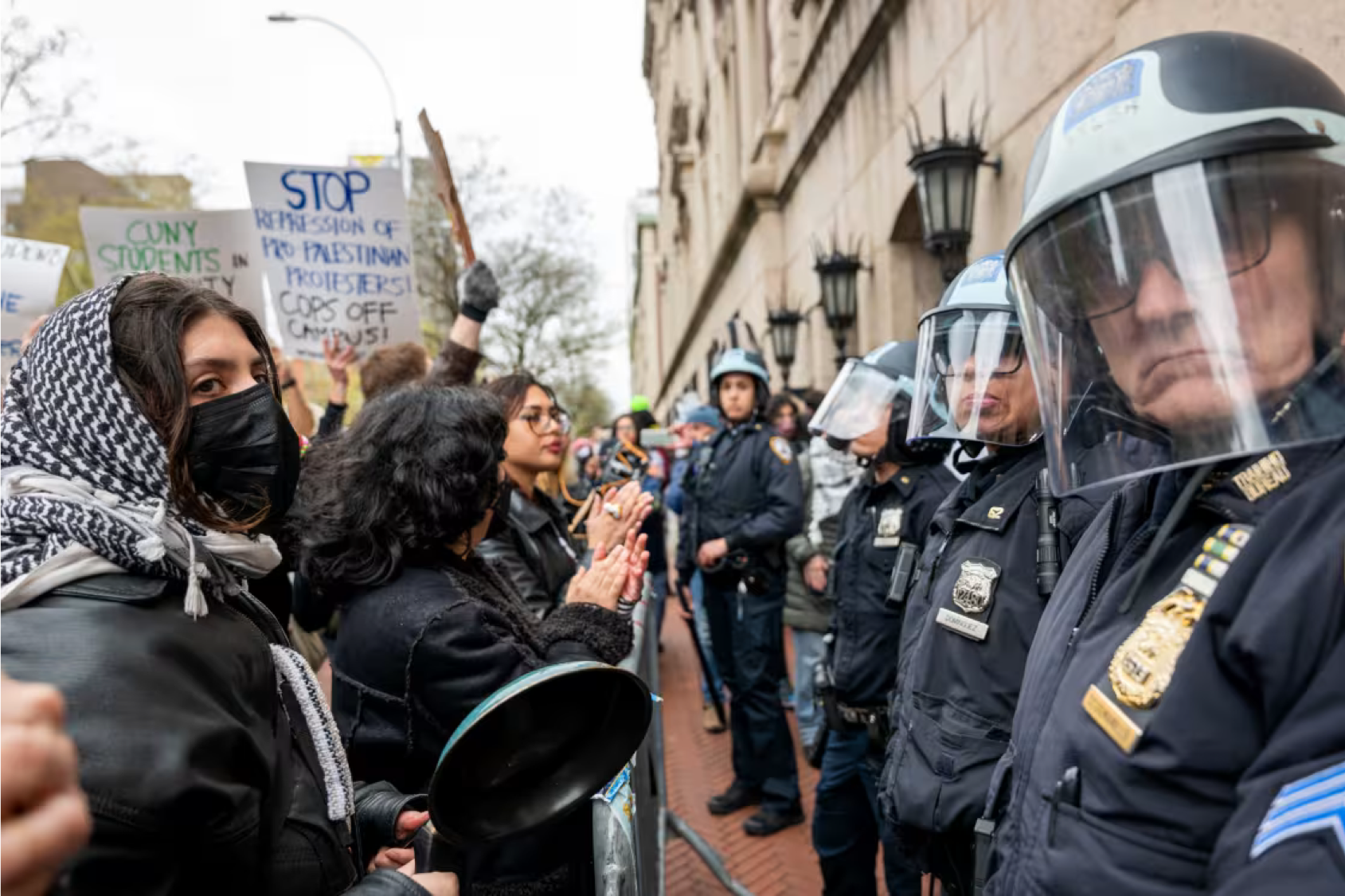
At Columbia University in 2024, President Minouche Shafik called in the New York City Police to shut down the encampment in solidarity with Palestine. The police violently arrested roughly 300 protesters across Columbia and City College. The general response from the campus community was that this was a needlessly hostile and totally disproportionate response to disruptive but nonviolent protests. One student who wasn’t involved in the protests said, “They’ve shut down everything. This is too intense…. It feels like more of an escalation than a de-escalation” (quoted in Monahan 2025, p. 308).

Source: Michael Nagle / Redux, The Atlantic (Fair Use)
Monahan (2025) recounts the range of surveillance measures the administration of Columbia implemented to counter protesters’ and students’ freedom of dissent and action: “The university installed additional video surveillance cameras, distributed mobile identity card readers to security staff, screened students entering buildings, established dossiers with photographs of students who were participating in or proximate to events, shared these digital files with public safety, and deployed ‘delegates’ to monitor demonstrations, photograph individuals, and check their IDs” (p. 308). The resulting surveillance footage was used in disciplinary proceedings against roughly 160 students. The university Board of Trustees co-chair, David Greenwald, unironically described this surveillance state in miniature as a positive outcome in an email to an alumnus donor unhappy with the protests.

Source: Spencer Platt / Getty Images, NBC News (Fair Use)
Fighting Back: Lessons from Black Lives Matter
In addressing this disturbing turn of events, Ross stressed using the same strategies that SDS and the student New Left had in the 1960s—building coalitions, raising awareness, protesting, and committing civil disobedience. But many students today legitimately worry about engaging in disruptive protest because they may face discipline, including expulsion, in an economy far less forgiving than that of the 1960s. Strategies that worked in the 1960s might not work today—today’s students will need to be creative in how they protest in campus. The chief lesson they should remember from the 1960s is that they can reclaim the space on campus their predecessors carved out.
In “Interactional Resistance During Black Lives Matter Protests,” Chloe Haimson (2020) discusses the creative techniques of BLM protesters in 2015 in two different cities (which she identifies only by pseudonyms, in line with the ethics of ethnographic research). In both cities, BLM protesters carefully studied how their city police departments handled protests, particularly at what tipping points they began making arrests. The activists then would take their protests right to the point where police would make arrests—then back down. They would create disruption by means such as blocking traffic while avoiding the worst of the dangers that come to African-Americans when they deal with the police. Crucially, these tipping points where BLM activists would back down to avoid arrests were different in the two cities because how the police operated was different in the two cities.

Source: Martin H. Simon / Redux, The Atlantic (Fair Use)
The BLM organizers also took actions like handing out fliers on what people should do if they were arrested and asking people to avoid interacting with the police, leaving that to protest leaders trained to do so in ways that would minimize the likelihood of arrest.
These actions didn’t eliminate the possibility of arrest—Haimson describes several cases where protest organizers had to carefully de-escalate situations that could easily have ended in an arrest—but they did minimize those possibilities.
Student activists should similarly study the policing and repression policies of the administration and campus police at their school. Some of this will be from their own experience and conversations with former students. Students should be familiar with official policies regarding protest and similar activities on campus—but should not expect those policies to be enforced fairly or consistently against all groups. Student activists can also make use of the online archives of student and local newspapers. They can use these to track which actions brought about a repressive police response and what punishments the administration handed out. This can also give students a sense of whether and how repression has escalated over time. That will allow them to better judge where they can push and take disruptive action—and where and when they will want to back down to avoid threats such as arrest, disciplinary action and expulsion.

Source: Mikhail Nilov, Pexels
Such research may also reveal where the administration has overreached and engaged in repressive actions that blew up in their face, embarrassing them and forcing them to back down. Students can use these to brainstorm creative ways to stymie the administration’s surveillance capabilities or embarrass the school into allowing greater room for dissent and protest.
Above all, they should remember that a previous generation of student activists in the 1960s created today’s freedoms on campus through dissent and protest—and that today’s student activists can repeat that feat.
If you are a student, faculty or staff on a college campus, what kinds of repression have you seen? Not just the obvious police repression, but the sort of repressive tolerance Marcuse wrote about? How have activists tried resisting this repression? How well has it worked?
References
Breines, Winifred. [1982] 1989. Community and Organization in the New Left, 1962-1968: The Great Refusal. 2nd ed. New Brunswick NJ: Rutgers University Press.
Brulé, Elizabeth. 2015. “Voices from the Margins: The Regulation of Student Activism in the New Corporate University.” Studies in Social Justice 9:159-175.
Haimson, Chloe. 2020. “Interactional Resistance During Black Lives Matter Protests: The Political Stakes of Rebelling Against the Public Order.” Mobilization 25:185-200.
Kapita, Amy, Héctor Ríos-Jara, and Selma Bratberg. 2026. “‘What You’re Doing Will Only Harm Yourself’: Understanding University Students’ Experiences of Coercive Repression.” Globalisation, Societies and Education 24:96-113.
Marcuse, Herbert. 1965. “Repressive Tolerance.” Olympia, WA: Evergreen State College. Retrieved September 2, 2026 (https://sites.evergreen.edu/arunchandra/wp-content/uploads/sites/395/2018/07/tolerance.pdf).
Miller, James. 1987. Democracy is in the Streets: From Port Huron to the Siege of Chicago. Cambridge, MA: Harvard University Press.
Monahan, Torin. 2025. “Silencing Dissent: Surveillance and Police Actions on University Campuses During Pro-Palestinian Protests.” Surveillance & Society 23:303-320.
Sculos, Bryant William and Sean Noah Walsh. 2016. “The Counterrevolutionary Campus: Herbert Marcuse and the Suppression of Student Protest Movements.” New Political Science 38:516-532.
Students for a Democratic Society. 1962. “The Port Huron Statement.” Tucson, AZ: The Sixties Project. Retrieved September 4, 2026 (https://www2.iath.virginia.edu/sixties/HTML_docs/Resources/Primary/Manifestos/SDS_Port_Huron.html).
Williams, Matthew. 2020. Strategizing Against Sweatshops: The Global Economy, Student Activism, and Worker Empowerment. Philadelphia: Temple University Press.
Creative Commons BY-NC-ND 4.0: Attribution-NonCommercial-NoDerivatives 4.0 International
Be the first to comment